Ask a pricing team what it costs to run terms data through three different quoting platforms. The answer that comes back first is almost always re-keying. The same discount levels and eligibility rules get typed into a second system, then a third. That answer is right. But it’s actually only the visible part of the cost.
The real cost sits underneath it. Errors creep in every time terms data is retyped rather than transferred automatically. Platforms quietly fall out of sync with each other, because nobody is checking all three at once. Strategic decisions end up being made on data that nobody in the business fully trusts any more. The same terms data has to exist in three separate places at once, and that duplication is what drives the cost.
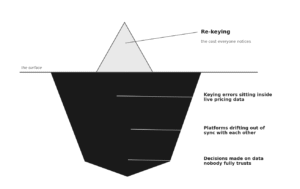
Re-keying is the part everyone notices. The real cost sits beneath the surface.
For a strategic pricing director, that trust gap is the real problem. Numbers coming out of three different platforms should always match. When they don’t, every decision built on top of them gets harder to defend. That is true of margin reviews, board reporting, and any conversation where someone asks how confident the business really is in its own pricing data.
Three ways multiple quoting platforms quietly cost you money
Every additional quoting platform is another point of failure for terms data. Add a second system, and the number of places a rate can go wrong doubles. Add a third, and it increases again. Each platform might work perfectly well on its own. The problem sits in the gaps between them, in the moment terms data has to move from one system to the next.
That gap is where the real cost shows up, and it breaks down into three distinct ways.
Duplicate data entry
Terms data entered into one quoting platform has to be entered again into the second. Then again into the third. The same team does it, for the same update, every time. None of that second and third entry is pricing work. It is retyping. Every hour spent on this is an hour the pricing team is not spending on the strategic work it actually exists to do. The more platforms a business runs, the more this scales: three platforms mean three entries, five platforms mean five.
Manual administration
Each of those manual entries is also a chance for a keying error. A rate typed one digit out. An eligibility rule applied to the wrong product. Manual administration at this volume doesn’t stay error-free for long, and small mistakes sitting inside pricing data are expensive ones to rectify. The error sits in the system until a quote goes out with the wrong number attached, and by then the mistake is already in front of the customer. A pricing team can build every control it likes into its own process but still can’t control what happens to a number after that number leaves its hands.
Reconciliation drift
Left long enough, the three platforms fall out of sync with each other. One system gets an update that another one misses, and nobody notices until a quote comes back with the wrong terms attached to it.
Reconciliation problems like this are widespread. Disconnected systems and spreadsheet workarounds produce the same result: a shadow version of the data drifting from what is true until it surfaces in a live quote or compliance review.
QV Systems covers this pattern in our guide to how asset finance platforms improve efficiency. Individually, each of these looks manageable. Together, they are what keeps a pricing team permanently behind on its own administration, instead of ahead on strategy. None of it shows up as a single, dramatic failure. It shows up as a team that is always a little bit behind.
The productivity cost of accepting inefficiency as normal
None of this stays contained to the pricing team. It reaches the wider commercial operations function the team sits within. Every hour spent re-keying terms data is an hour not spent on pricing strategy. It is an hour not spent supporting prospect quoting, which is the work the rest of the business relies on that team to deliver. The errors introduced by manual entry do not stay theoretical either. They carry the same financial discrepancies and those discrepancies tend to surface in board reports long after the original keying error has been forgotten.
The businesses running one connected system instead of three have already solved this problem. Every quarter a competitor spends re-keying is a quarter another leasing or lending business spends pricing instead. That business is quoting faster and winning the deal in front of the same customer. Treating multiple systems as normal means accepting a cost that competitors are no longer paying. Competitive advantage rarely comes from the quoting platform itself. It comes from what a team does with the time it gets back once the platform stops holding them back.
The single-source model for enterprise terms management
The alternative is a different architecture. Terms data gets managed once, in a central system. From there, it publishes automatically to every quoting platform that needs it. This is the model behind Accelerate, QV Systems’ platform for lenders and leasing companies.
That removes the second and third entry. There is no second or third place for the data to live. It removes the drift as well. Every platform reads from the same live source, rather than keeping its own copy. One place to maintain, update and audit instead of three. As we’ve covered in our guide to what to look for in vehicle lease management software, this kind of API-first distribution is now the baseline expectation for any platform handling data at volume. The same principle applies just as directly to the rekeying and operational risk that builds up wherever terms data still moves between systems by hand.
It also means one historic record instead of three partial ones. Anyone asking what terms were live on a given date gets a straight answer, instead of three different files to reconcile before they can even start.
Stop managing systems. Start managing margins
Running terms data through three different quoting platforms is never a deliberate choice. It is what happens when systems get added one at a time. Each one solves an immediate problem. Slowly, re-keying, drift and reconciliation become the accepted cost of doing business, without anyone deciding that they should. Nobody sits down and designs a three-system process on purpose. It simply accumulates, one platform at a time, until undoing it feels harder than living with it.
Accelerate’s Terms Management module removes that cost. Terms data gets centralised in one place. From there, it publishes automatically to every platform downstream. Pricing teams stop managing systems and start managing margins instead. This means less time keeping three platforms aligned and more time on the pricing decisions that actually grow the business.
If your pricing team is still running terms data through multiple systems, talk to the QV Systems team about it. Find out how Accelerate brings it all under one roof.
Discover strategic terms management