Ask any pricing manager at an enterprise leasing company how much of their team’s time goes on data entry, and the honest answer is far more than it should. When a new set of OEM terms lands, someone with years of commercial expertise sits down and types rate structures, discount levels and eligibility rules into a quoting system. They then do it again in the next system, and again in the one after that, because that is the only way the numbers reach the people who need them.
Re-keying is just the most visible symptom of a deeper problem: a quoting tool being asked to do a job it was never designed for.
A quoting platform exists to calculate a quote at the point of sale, built for a single moment in time rather than a living, changing set of terms data. Asking it to hold and manage that data is like fitting a square peg into a round hole: it can be forced to fit, but only with damage. That damage shows up as repeat data entry, keying errors, blind spots on what changed and when, and updates that get slower every time OEM terms change.
What a quoting platform can’t do that a terms platform can
Quoting tools are built to answer one question well: what does this deal cost right now? They are not built to remember what the terms were last month, to connect to the other systems that also need those terms, or to cope with the sheer number of terms sets now moving through the business. Three specific gaps explain why the workload keeps growing rather than shrinking.
No memory of what came before
A quoting tool keeps no historical record. The moment new terms are entered, the previous version disappears from view. There is no built-in way to see what changed, when it changed, or why a quote calculated three weeks ago used different numbers to one calculated today. Any audit trail has to be built and maintained separately, by hand, outside the system that is supposed to be doing the work.
No connection to the rest of the business
Quoting tools don’t talk to each other, or to anything else. Every platform that needs pricing and terms data needs the same information typed in separately. Each of those manual entries is another opportunity for a keying error, and once an error is in the system, it can sit there undetected until it surfaces in a live quote to a customer.
Not built for today’s volume
This gap was manageable years ago, when a small number of large OEMs issued a handful of terms updates annually, but that manageability has not survived today’s volume.
“Terms entry is a full-time job at a leasing company of any scale. Back in 2009, a team of five to six people would need weeks of extra support every January just to clear the OEM backlog.”
Daniel Layne, CEO, QV Systems
Three shifts since then have made the job harder still. OEMs now extend terms to smaller end-user companies too, adding more sets of terms into circulation across the market; the UK’s leased vehicle fleet has grown 7.2% year on year to more than 2.05 million vehicles, and manufacturer discounting has become more aggressive as competition for that volume increases. OEMs are also changing terms more frequently than before. Where OEMs now issue terms as a CSV file for upload, that work simply moves rather than disappears: somebody in IT still has to build and maintain an ingestion routine for every format the business receives. If that business runs more than one quoting system, someone still has to upload the same file in more than one place, assuming every system has an uploader to begin with.
The competitive cost of disconnected terms management
None of this stays contained within the pricing team. Every extra day between an OEM issuing new terms and those terms going live across the business is a day where quotes may be wrong, deals may be delayed, and competitors who move faster are winning business that should have been yours. Three consequences follow directly from delayed, manual terms management.
- 1. Margin is left on the table
Delayed price changes or new incentives mean deals get written against stale terms, eroding margin that nobody notices until reconciliation, by which point it cannot be recovered. - 2. Rate errors and financial discrepancies
Manual re-entry is precisely where mistakes enter a system, and mistakes in pricing data are expensive to unwind. Recent research into data quality found that more than a quarter of organisations now estimate losses of over five million US dollars a year from poor data quality alone, with 7% reporting losses above twenty-five million. For a leasing business processing thousands of quotes a month, even a small error rate compounds quickly into a material commercial problem. - 3. Missed market windows
While your team is still re-keying, a competitor with faster terms turnaround is already quoting the deal in front of your customer.
The result is a pricing team that spends its time protecting the business from its own systems, rather than using its expertise to win more business for it.
The single-source model for enterprise terms management
The fix is a different architecture: a dedicated terms management layer that sits between the OEM and every system that needs pricing data, so terms are entered once and reach everywhere automatically, rather than being retyped everywhere by hand. This is the model behind Accelerate, QV Systems’ platform for enterprise lending and leasing companies.
One place to manage every set of terms
Instead of terms living separately inside each quoting tool, they live in a single, dedicated platform built specifically for the job. New terms, discount structures and eligibility rules are entered once, and every previous version is retained automatically. This gives pricing teams the version history and audit trail that a quoting tool was never able to provide.
Automatic distribution through APIs
Once terms are set centrally, APIs push the update out to every downstream quoting tool automatically and immediately, replacing the CSV exports, repeat logins and catch-up delays that manual distribution requires. As we have covered in our guide to what to look for in vehicle lease management software, API-first integration is now the baseline expectation for any platform handling data at this volume, and terms management is no exception.
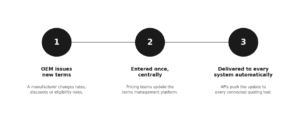
Terms are entered once and reach every connected system automatically, with no manual step in between.
This model does more than save time. It removes the specific failure points set out above. There is one record of what the terms were and when they changed, one place to update them, and no manual step between the OEM issuing new terms and the quote a customer eventually sees.
Reclaiming your pricing team’s strategic value
A quoting platform calculates a quote at the point of sale; managing terms data was never part of the job. Every hour your pricing team spends re-keying, is an hour that they’re not adding commercial value. As deal volumes grow, that cost only widens. The same pattern plays out across automotive finance more broadly: rekeying between disconnected systems is consistently where operational risk builds up first.
Accelerate’s Terms Management module gives terms data the dedicated home it has always needed, separate from the quoting tools that were never designed to hold it. Pricing and commercial teams get one place to manage every set of terms, with automatic API delivery of every update to every system that needs it downstream, and a complete audit trail to prove exactly what changed and when.
If your pricing experts are still re-keying rather than pricing, talk to the QV Systems team about how Accelerate’s Terms Management module can take that job off their plate, and put their expertise back where it belongs: on pricing.
Discover strategic terms management